
High Resolution Spectroscopy

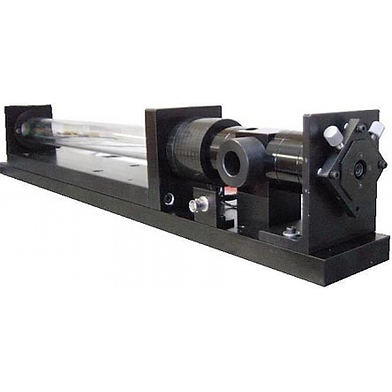
Confocal Interferometer (CFP-1)
The Confocal Interferometer CFP-1 is an advanced high-resolution spectrometer, featuring a 500 mm confocal cavity that delivers a resolution close to 5 MHz. The CFP-1 includes specialized optics to ensure optimal coupling of an optical fiber to the cavity. To minimize stray light, a narrow bandpass interference filter is employed, while a glass plate beam splitter diverts a small portion of the incoming light for reference purposes.
The cavity is pre-adjusted at the factory for optimal performance and does not require further adjustment under normal operation. However, alignment screws are available for rare instances where recalibration might be needed.
The system utilizes highly sensitive piezoelectric scanning, operating at approximately 1.75 V per order with a wavelength of 532 nm.
Confocal Microscope (CM-1)
Designed for seamless installation and operation with Tablestable TFP Fabry-Peròt spectrometers, the CM-1 is both easily removable and maintenance-free, allowing for depolarized, polarized, and unpolarized scattering measurements without altering the internal optical path.
Featuring a large reach (130 mm) and optical working plane height (min. 147 mm), the CM-1 includes a long-working-distance apochromatic objective with a numerical aperture of 0.42 NA, delivering sub-micron resolution better than 1 μm.


Multichannel Analyzer (MCA-1)
The Tandem Interferometer uses a photomultiplier in single-photon counting mode to detect light, converting detected photons into TTL pulses. During scans, pulses are counted into digital data channels, forming a histogram that represents the spectrum. For weak signals, repetitive scanning prevents alignment drift, gradually building intensity over time.
The GhostMCA handles these functions and connects to a PC using an RS-232 port for data acquisition and visualization using dedicated software. Older control units without MCA hardware can use an external MCA box as an alternative.
Laser Filter (TCF-2)
The TCF is a temperature-stabilized etalon device designed to suppress spurious secondary laser modes, which can interfere with Brillouin spectroscopy by appearing in the background. It effectively attenuates these modes, often below the detection threshold. The core component is a thin etalon plate available for red (613–653 nm), green (512–552 nm), and blue (440–480 nm) regions, with etalons for other colors and a high-power green version (512–552 nm) available on request.
The upgraded TCF-2 includes a stabilizer that adjusts the temperature setpoint to maintain optimal tuning and maximum output, compensating for room temperature and wavelength drifts. The stabilizer can also be purchased separately to upgrade TCF-1 devices. TCF units are compatible with both imperial and metric standard optical tables.


Light Modulator
The Light Modulator (LM-2) is double shutter system designed to control light intensity for both back-and-front scattering setups. This device is fully compatible with the TFP and is positioned behind the entrance pinhole of the spectrometer.
For strong elastic signals, the shutter SH1 closes during scans through the elastic peak, while additional light for stabilization is introduced through a secondary pinhole with SH2 open. For weak signals, both shutters remain open. If extra light disrupts measurements, SH2 alternates between cycles of stabilizing scans and experimental signal recording. All control signals are readily accessible, eliminating previous interfacing challenges.
Brewster Attenuator (BA-1)
The TFP Interferometers require a low reference laser intensity of approximately 1-2 mW for stabilization. The Brewster Attenuator is an efficient and practical tool for achieving this intensity.
Positioned near the laser source, the Brewster Attenuator transmits nearly 100% of the laser intensity when aligned parallel to the laser’s polarization. By slightly rotating the device’s head, a small portion of the light is diverted into an optical fiber, which directly connects to the TFP to supply the reference intensity. The fiber coupling is compatible with FC/PC fiber optics patch cables and comes equipped with a suitable patch fiber cord for seamless integration.


Pinhole Viewer (PV-1)
This microscope is designed to view scattered light as it is focused onto the plane of the entrance pinhole of the Interferometer. By observing from behind the input pinhole, the scattering optics can be adjusted for optimal light collection. Additionally, the microscope facilitates precise alignment of the reference beam with the measurement beam.
To operate, move the lever on the side downward to activate the viewing mode and upward to switch to the measurement mode.
Pinhole Camera
The CMOS sensor camera captures the pinhole plane, enabling precise alignment of both the input beam and the spectrometer's reference signal to the center of the smallest available pinhole. The camera connects to a PC via a USB link for seamless operation.
For experimental setups with external optical configurations, the camera—paired with a gathering lens focused on the sample surface—can assist in accurately positioning the sample. When used as part of the confocal microscope appendix CM-1, the camera tube includes a filter to make a strong laser signal visible on the sample surface.


BLS Mini Setup
The miniature BLS setup is a compact, fully integrated back-scattering system designed for placement directly before the input pinhole of a TFP spectrometer. It enables back-scattering measurements on test samples without requiring additional equipment on the workbench or interfering with an existing setup.
This setup includes a 50:50 beam splitter, gathering and focusing lenses, and a small sample space. The focus and position of the focusing lens are adjustable, ensuring the back-scattered radiation from the sample is directed to the TFP spectrometer. When paired with a reference sample, the miniature BLS setup provides a quick and reliable method for assessing device efficiency as needed.